
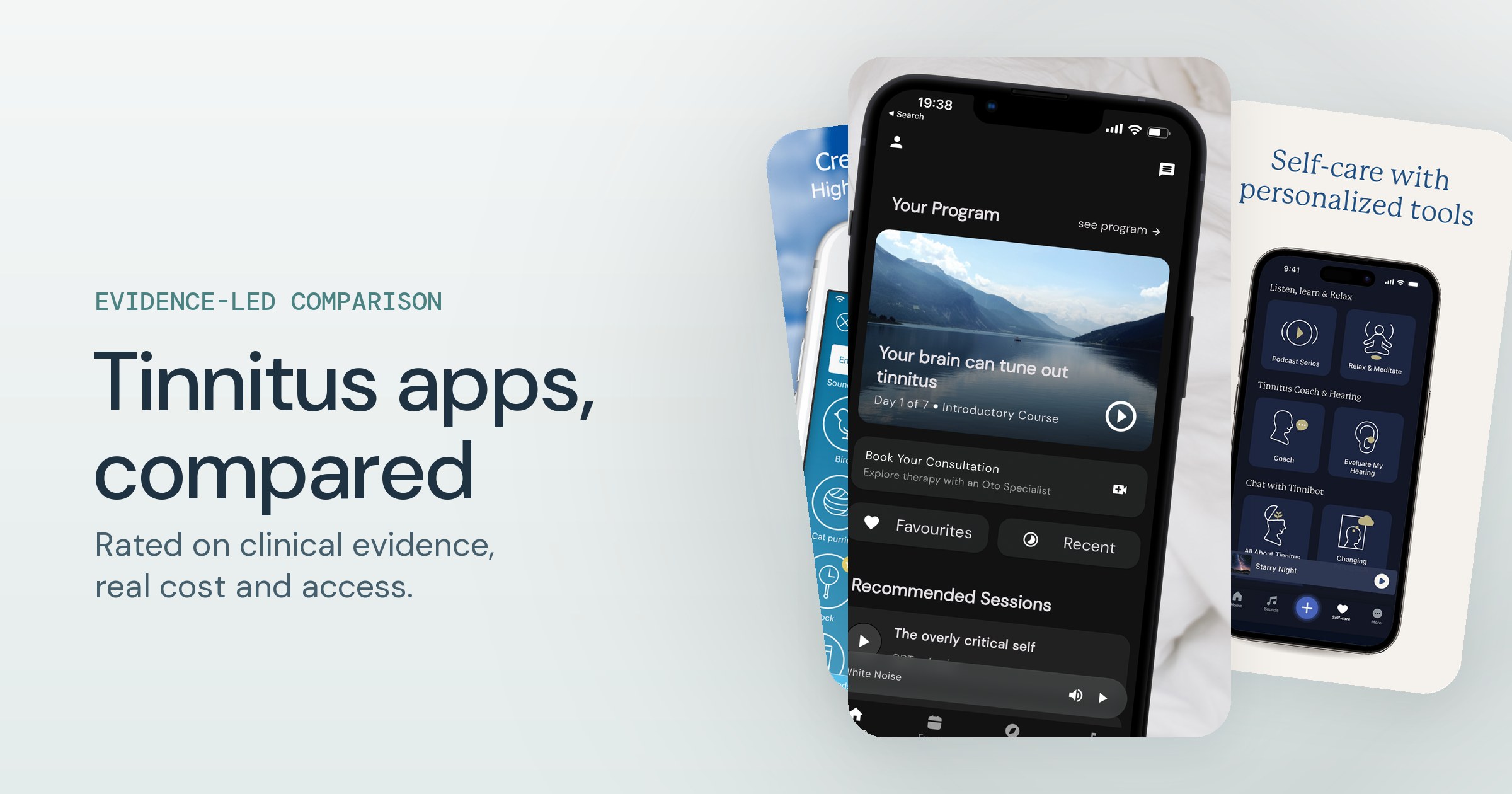
There are dozens of tinnitus apps, and most reviews of them skip the three things that matter most:
- Whether there is real research on the app itself.
- What it actually costs.
- How much of your day it needs.
This guide compares the tinnitus apps a US patient is most likely to come across, asking the same questions of every one, and showing our work.
One note first, in the interest of transparency. Oto, one of the apps below, is made by us. We have held our own app to the same standard as the rest, we show where other apps beat it, and every study and price is sourced at the bottom.
Top picks by use case
 Most research behind it
Oto
More published clinical research than any other app here, though you use it with a clinician.
 Best free place to start
ReSound Tinnitus Relief
A genuinely full, free sound-therapy app you can start using tonight.
 Most control, lowest cost
myNoise
A large library of soundscapes you tune slider by slider, for a one-time $19.99.
 Self-guided CBT
MindEar
A structured eight-week CBT program with a chat coach, no clinician needed.
At a glance
| App | What it is | Cost in the US | Research on the app itself | App Store rating |
|---|---|---|---|---|
| Oto | Sound therapy program, used with a tinnitus specialist | Included in your clinic's care plan, no separate charge | The most here: two university trials plus a feasibility study | 4.7★ (845) |
| ReSound Tinnitus Relief | Sound-therapy library | Free; optional plan $6.99/mo or $69.99/yr | One study, with no comparison group | 4.7★ (18,692) |
| myNoise | Customizable sound-masking library | Free; one-time $19.99 to unlock everything | None, and it makes no medical claim | 4.7★ (949) |
| MindEar | Self-guided CBT with a chat coach | Free to start, then about $6/mo or $59 to $69/yr | One pilot and one larger trial, both company-linked | 4.5★ (464) |
| Widex Zen | Fractal-tone sound therapy | Free | Only for the in-clinic protocol, not the app alone | 4.2★ (40) |
| AudioCardio | Passive sound conditioning | Free trial, then $9.99 to $99.99 | None on the app for tinnitus | 4.2★ (342) |
| Neuromonics | Acoustic music therapy plus coaching, through a clinician | $199.99/mo for the program, then $29.99/mo | Older device trials only, nothing on the current app | 3.1★ (9) |
How we compared them
We included the tinnitus apps a US patient is most likely to come across: ones you can actually get in the US, and ones people search for or get recommended. We left out apps you cannot use here, and tools with almost no footprint.
We asked the same five questions of each app:
- What it actually does.
- Whether there is published research on the app itself.
- What it really costs in the US.
- How you get it.
- How much daily time it asks for.
One thing about evidence is worth understanding, because it is where a lot of tinnitus marketing gets slippery. There is plenty of research on the techniques, like CBT for tinnitus or sound therapy in general. That is not the same as research on a specific app. We only count a study as evidence for an app if that study actually tested that app.
Two of these are programs you get through a clinician
Two options are not download-and-go apps. You get them through a clinician, as part of a program. They are also the two ends of the spectrum in this guide: one has the most research behind it, the other the least on its current form.
Oto
Sound therapy program, used with a tinnitus specialist
- Cost in the US
- Included in your clinic's care plan, no separate charge
- What it contains
- A sound library, plus audio sessions covering education, relaxation and mindfulness and exercises drawing on cognitive behavioral techniques
- Research on the app
- The most here: two university trials and a feasibility study
- Platforms
- iOS and Android, through a provider
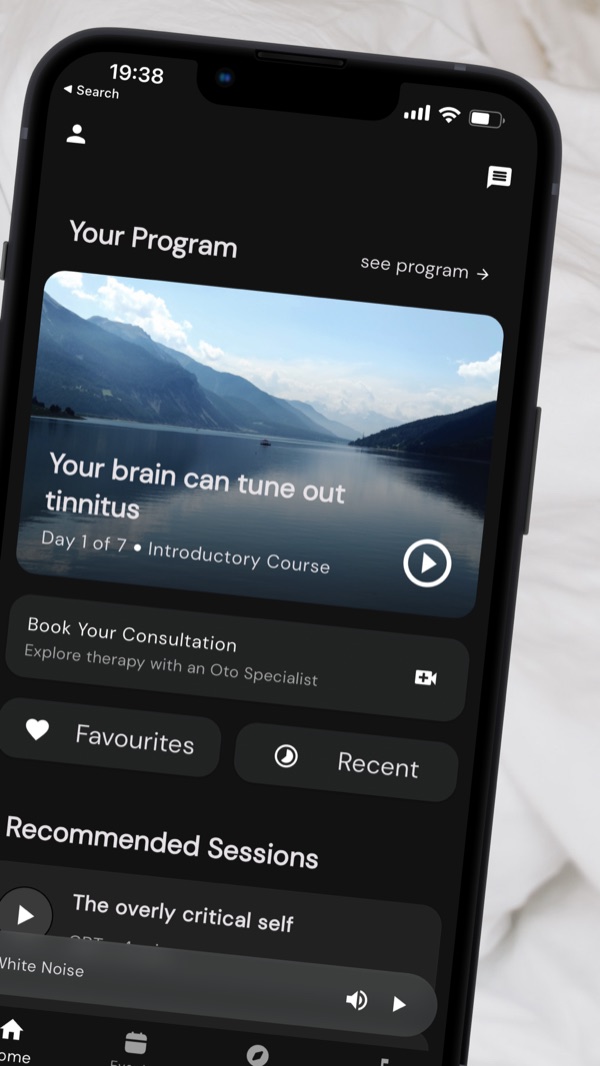
Oto is the most clinical option here, used alongside care from a tinnitus specialist rather than on your own. You see an audiologist or doctor who assesses your tinnitus and hearing and builds a plan around you, and the app supports that plan with a sound library, plus short audio sessions covering education, relaxation and mindfulness and exercises drawing on cognitive behavioral techniques.
Best forPeople who want the most clinical, most personalized option and are happy to work with a tinnitus specialist. Not the pick if you want to sort it yourself without seeing anyone.
Because a professional sets it up and follows your progress, the plan is personalized and overseen by someone who knows tinnitus. Day to day, you do a five to ten minute guided session (breathing, a CBT exercise or a "skill of the day") and can dip into a sound library of white, pink and brown noise, nature sounds and layered soundscapes, including a background sound you set around your own tinnitus. There is a wind-down session for sleep, and your clinician can track your progress and adjust the plan.
The research: Oto has more published clinical research than any other app in this guide. A randomized controlled trial run by Flinders University in 2025 is published (Mui et al., 2025). A larger University of Cambridge trial, DEFINE, has finished and is in peer review. An earlier feasibility study preceded both, and for transparency, one of its co-authors is a co-founder of Oto.
Cost and access: Oto is not sold on its own and is not a separate charge. It is included in a tinnitus care plan from a participating clinic. If your clinic recommends a hearing device, Oto is included alongside it at no extra cost; if not, it is part of a basic care plan (these typically run $500 to $1,000, set by the clinic, with Oto included). Either way, you are paying for your care, not for the app. You can find a provider near you.
Ratings and reviews: 4.7★ on the App Store (845 reviews), around 4.0★ on Google Play. Reviewers most often mention the audio sessions and breathing exercises, and like that the short daily format is easy to keep up.
The catch, and the point: Oto is not a download-and-go app. The full program comes through your clinic, not a self sign-up. You can download a free demo to get a feel for it, but to unlock everything you go through a provider. That clinician-led setup is what makes it the most thorough and most personalized option here, and it is also the honest downside: if you would rather not see a clinician at all, one of the free apps below will suit you better.

Neuromonics
Acoustic music therapy plus coaching, through a clinician
- Cost in the US
- $199.99/mo for the guided program, then $29.99/mo
- Therapy
- Customized acoustic music therapy plus counseling
- Research on the app
- Older device trials only, nothing on the current app
- Platforms
- iOS, through a clinician
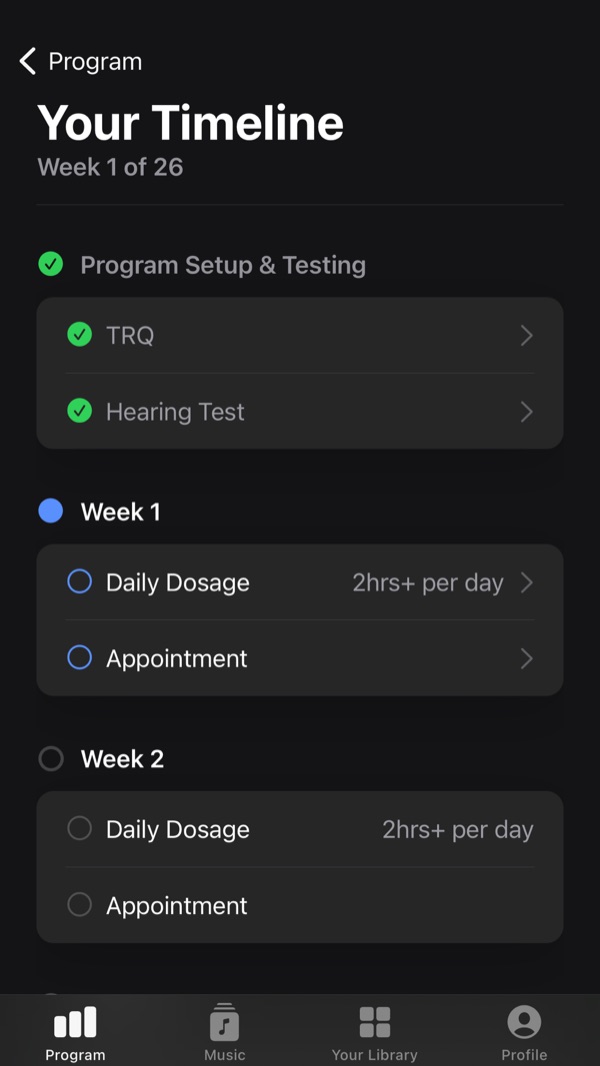
Neuromonics is a supervised, six-month program. After an assessment with a certified specialist, the app plays music that has been acoustically modified and tuned to your hearing, which you listen to for two or more hours a day, alongside one-to-one coaching.
Best forPeople set on a clinician-guided acoustic-therapy program who are comfortable with the high cost and the daily commitment, and who do not mind that the current app is unproven and lightly reviewed.
It used to be delivered on a dedicated device, and was rebuilt as an app after the company was acquired (it is now run by a firm called SoundVida).
The research: Neuromonics has a genuine history of controlled trials, but they were done on the original device version (Davis et al., 2007 and 2008), not the current app. As far as we can find, the app-and-telehealth version has not been studied on its own. The original device was cleared by the FDA back in 2005.
Cost and access: this is the most expensive and most demanding option here. You enroll through a clinician, the guided program is $199.99 a month, and it drops to $29.99 a month for maintenance afterwards. It asks for two or more hours of listening a day for six months.
Ratings and reviews: the current app has just 3.1★ from only 9 App Store ratings, so there is very little user feedback to go on, and what there is centers on a clunky sign-up (you have to get a clinician code before you can really start). Treat it as a small, early relaunch.
Apps you can download and use yourself
These you can install today. They run from free sound tools to paid CBT programs. Free to download does not always mean free to use, so we have flagged what actually costs money.
ReSound Tinnitus Relief
Sound-therapy library, free to start
- Cost in the US
- Free; optional plan $6.99/mo or $69.99/yr
- Therapy
- Layered sound therapy and relaxation
- Research on the app
- One study, with no comparison group
- Platforms
- iOS and Android
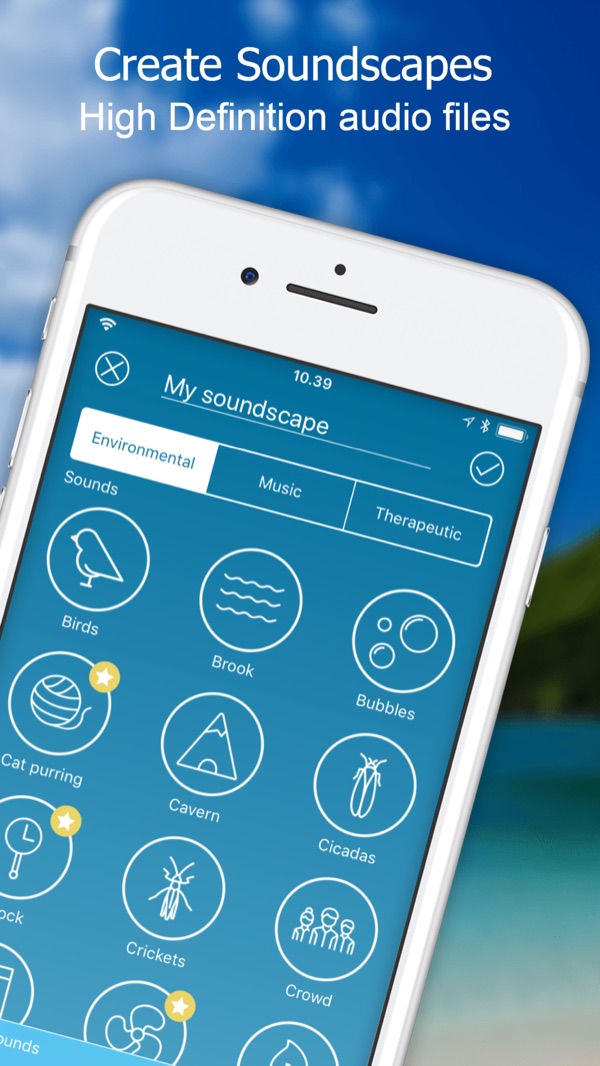
ReSound Tinnitus Relief is the best free place to start. You do not need a ReSound hearing aid; everything plays through your phone or any headphones. You build your own soundscape by layering up to five sounds (nature sounds, plus white and other noise), save your mixes, and set a timer.
Best forAnyone who wants a solid, free sound-therapy toolkit, especially for sleep.
A "Relax" section adds guided meditations, breathing exercises and calming imagery, and there is a short "Learn" section on tinnitus. There is no set daily routine; most people use it at bedtime or in stressful moments.
Cost: the core app is genuinely free, with everything above included. There is an optional premium plan ($6.99 a month or $69.99 a year) that adds a personalized weekly plan, but you do not need it to get real value.
Ratings and reviews: one of the most-reviewed apps in the category, 4.7★ on the App Store from over 18,000 reviews, and roughly 4.4★ on Google Play with around 800,000 downloads. People call it a life-saver for sleep and nighttime tinnitus and like that the free version is genuinely full. The common complaint is reliability: the sound sometimes stops during a long overnight timer, or an incoming call interrupts it.
Worth knowing: Beltone Tinnitus Calmer is the same app from the same parent company, so if you wear Beltone hearing aids, that is the matching version. One catch: Beltone's app is currently only on iPhone, it has been pulled from the Google Play store, so Android users should use ReSound.
myNoise
Customizable sound-masking library
- Cost in the US
- Free; one-time $19.99 to unlock everything
- Therapy
- Customizable sound masking
- Research on the app
- None, and it makes no medical claim
- Platforms
- iOS, Android and web
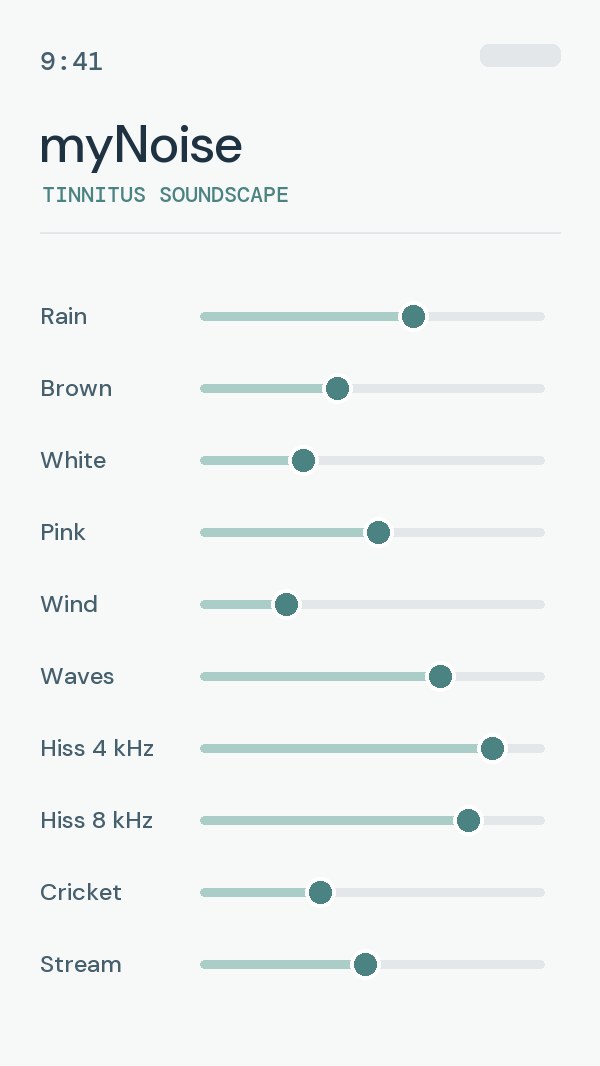
myNoise gives you the most control over your sound for almost nothing. It is a library of 300-plus adjustable soundscapes, built by one Belgian sound engineer, and several are made for tinnitus. Instead of one volume knob, each sound has up to ten sliders you move across the pitch range, so you can shape it precisely.
Best forPeople who want to fine-tune their own masking sound and avoid subscriptions.
There is a tinnitus tool where you raise only the bands that match your own tinnitus, aiming for the quietest sound that blends with the ringing rather than drowning it. An optional calibration tunes everything to your headphones and hearing.
Cost: free to try (a 14-day full unlock), then a single one-time purchase of $19.99 to keep the whole library. No subscription, no ads. The same sounds are free to use on the myNoise website in a browser.
Ratings and reviews: 4.7★ on the App Store (949 reviews) and about 4.4★ on Google Play (500,000-plus downloads), and the website reaches far more people than the app does. People love the depth of control, the quality of the real recordings, and the one-time price. The recurring complaint is that saved custom mixes can disappear after a crash or an update, so back them up.
The research: none, and to its credit, myNoise does not claim any. It is a sound tool, not a medical program.
MindEar
Self-guided CBT with a chat coach
- Cost in the US
- Free to start, then about $6/mo or $59 to $69/yr
- Therapy
- Self-guided CBT plus soundscapes
- Research on the app
- One pilot and one larger trial, both company-linked
- Platforms
- iOS and Android
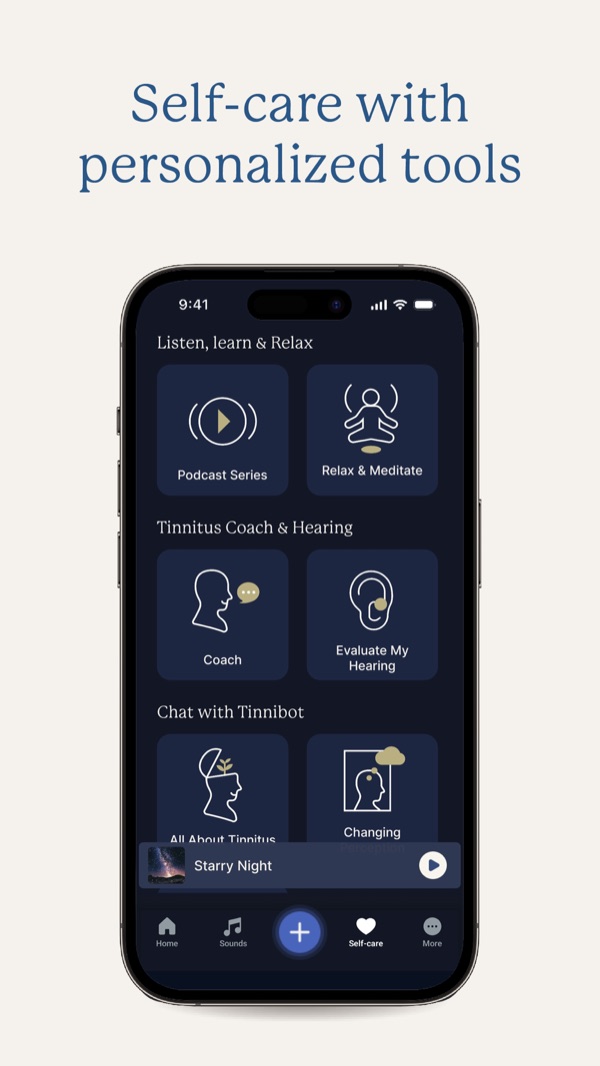
MindEar is the pick if you want structured CBT on your own, without seeing a clinician. It is a self-guided, roughly eight-week program built around a chat coach that is available any time and walks you through cognitive behavioral therapy techniques a little at a time, plus soundscapes, guided sleep sessions and a podcast.
Best forPeople who want to try structured CBT on their own phone.
The chat coach covers education, coping strategies and exercises to change how your brain reacts to the sound. It comes out of tinnitus research at the University of Auckland, and offers a free 15-minute consultation with a tinnitus expert when you start. CBT is the approach with the strongest overall evidence for reducing tinnitus distress.
Cost: free to start, then a subscription for the full program, around $6 a month or $59 to $69 a year. (Their store listing shows several prices at once, so check what you are quoted before you buy.)
Ratings and reviews: 4.5★ on the App Store (464 reviews) and about 3.8★ on Google Play (10,000-plus installs). People like the breathing and relaxation exercises most, and that it is research-backed. The complaints are mostly technical: glitches, being asked to log in again after paying, and a hearing check that did not always show results.
The research: MindEar has a small pilot and a larger trial behind it (Jackson et al., 2026, found a meaningful drop in tinnitus distress over eight weeks). Both studies involve people connected to the company, so treat them as promising rather than fully independent.
Widex Zen
Fractal-tone sound therapy, completely free
- Cost in the US
- Completely free, no in-app purchases
- Therapy
- Fractal-tone sound therapy
- Research on the app
- Only for the in-clinic protocol, not the app alone
- Platforms
- iOS and Android
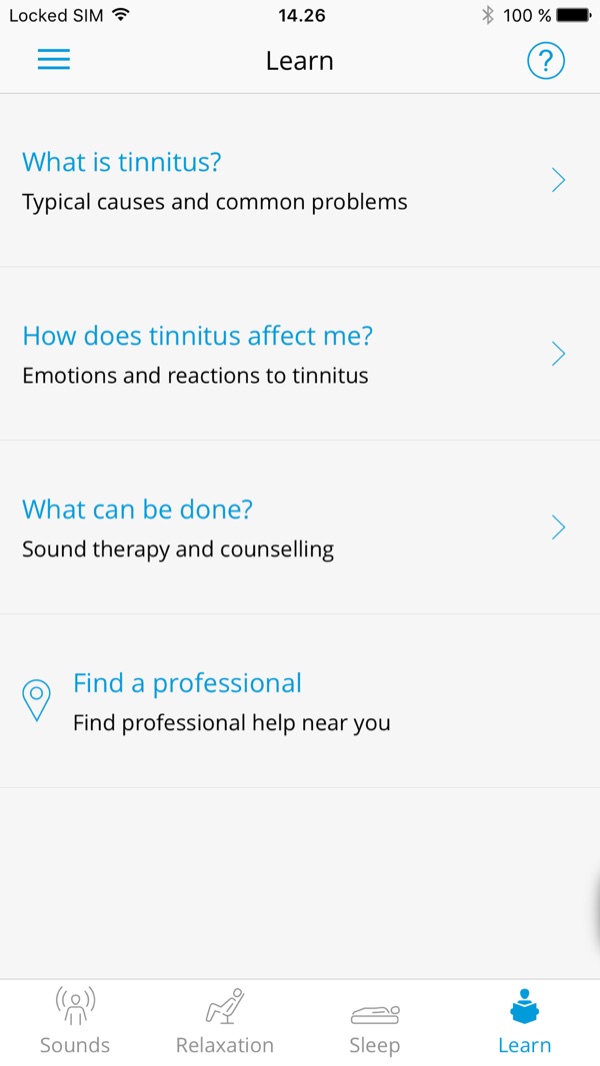
Widex Zen plays "fractal tones", gentle, non-repeating chime-like sounds meant to relax you and take your attention off the tinnitus, across five tone styles plus a plain noise option. You can use it without a Widex hearing aid; it works through your phone or any headphones.
Best forPeople who find fractal tones soothing, or who already use Widex hearing aids with their audiologist.
Widex's own store listing frames it as an add-on to a professional Widex fitting rather than a standalone therapy. Widex suggests listening two to four hours a day at a soft background level.
Cost: completely free, with no subscription and no in-app purchases.
Ratings and reviews: this is the quietest app here. 4.2★ on the App Store from just 40 reviews, and it has not been updated since 2023, so it feels neglected next to the others. The people who use it like the fractal tones for sleep and focus.
The research: the studies on Widex Zen are for the full in-clinic therapy (tones combined with hearing aids and counseling), not the free app on its own.

AudioCardio
Passive sound conditioning
- Cost in the US
- 14-day free trial, then $9.99 to $99.99
- Therapy
- Passive sound conditioning (near-inaudible tones)
- Research on the app
- None on the app for tinnitus
- Platforms
- iOS and Android
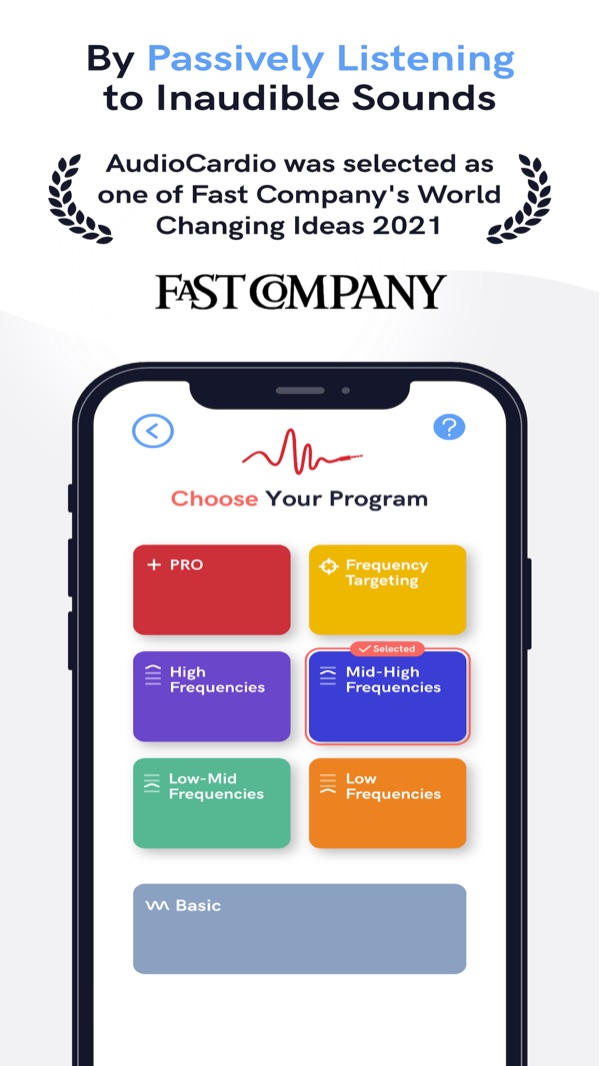
AudioCardio takes a different route from everything else here. Rather than masking the tinnitus, it plays personalized, almost-inaudible tones matched to your hearing test, in the background for about an hour a day, on the idea that gently stimulating your weaker hearing frequencies may help over time.
Best forPeople curious about a hearing-conditioning approach who understand the evidence for this specific app is thin, and who will stop if their tinnitus feels worse.
You do a quick in-app hearing check, it builds a track targeting your weak spots, and you play it under music or work without paying attention to it. You retake the check every so often so it recalibrates.
Cost: a 14-day free trial, then a subscription: $9.99 a month for the basic tier, $12.99 a month (or $99.99 a year) for the higher tier that targets more frequencies.
Ratings and reviews: 4.2★ on the App Store (342 reviews) and around 3.1★ on Google Play (50,000-plus installs). Fans like that it is passive and fits into the day, and some report clearer hearing. The critics are blunter: several long-term users report no change after months and call it expensive for what it is, and a few report their tinnitus feeling worse after starting.
The research: AudioCardio's marketing points to a long list of studies, but those are about the general science of sound conditioning, not tests of this app, and much of it is not about tinnitus. We could not find an independent trial of the AudioCardio app for tinnitus. The app's own terms state it is not an FDA-reviewed medical device, and, notably, they warn that "rare" cases of worsened hearing conditions have been reported with intensive frequency stimulation, which lines up with those few negative reports.
Apps you will see mentioned but cannot get in the US
If you have been reading around, you may see Kalmeda come up. It is a prescription tinnitus app available in Germany, not in the US. Some older programs and devices get talked about online too but are either discontinued or hard to get here. We have stuck to what a US patient can actually use today.
So which tinnitus app should you choose?
There is no single best tinnitus app, because the right one depends on where you are.
- Want the most clinical, best-researched option, and happy to see a specialist? Oto.
- Want the best free place to start on your own? ReSound Tinnitus Relief.
- Want the most control over your own masking sound, for a one-off $20? myNoise.
- Want structured CBT without seeing a clinician? MindEar.
Whichever you pick, an app tends to work best as part of a plan rather than on its own, and sticking with it matters more than which one you choose. And if your tinnitus is new, pulses in time with your heartbeat, is in one ear only, or came alongside dizziness or hearing loss, see a clinician first. Some tinnitus needs a medical check before you reach for an app.
And if you are struggling with your mental health, talk to someone first. Suicidal thoughts, severe depression, or a mental health condition that feels unmanageable all mean your primary care provider or a mental health professional is the right first call. Digital tinnitus tools are not the right starting point.
Oto is intended for adults 18 years and older with chronic, bothersome tinnitus.
Frequently asked questions
Do tinnitus apps actually work?
For many people, the right approach can genuinely reduce how much tinnitus bothers them, though not by silencing the sound itself. The strongest evidence is for CBT-based techniques, and for some people, sound therapy helps too. Results vary a lot from person to person, and an app usually works best alongside support from a clinician.
What is the best tinnitus app?
There is no single best one. Oto has the most published research behind it, though you use it with a clinician. For a free start on your own, ReSound Tinnitus Relief is the fullest option, and myNoise gives you the most control for a one-off price. For self-guided CBT, MindEar.
Are there free tinnitus apps?
Yes. ReSound Tinnitus Relief and Widex Zen are free to use, and myNoise is free to try then a one-time $19.99. Some apps are free to download but charge for the full program, so check before you commit.
Is there a clinically proven tinnitus app?
"Proven" is a strong word for any tinnitus app. A few have been tested in clinical studies on the app itself, and most have not. Oto has the most, with university-led trials and a larger trial (DEFINE) awaiting publication. Many popular apps have no published research on the app specifically.
How much does the Oto app cost?
In the US, Oto is not sold on its own or charged separately. It is included in a tinnitus care plan from a participating clinic, either alongside a hearing device at no extra cost, or as part of a basic care plan (typically $500 to $1,000, set by the clinic, with Oto included). You can find a provider to get started.
Which tinnitus app is best for sleep?
Many people find a free sound-therapy app easiest for sleep, and ReSound Tinnitus Relief is the most-praised here for nighttime use. myNoise is a good choice if you want to shape the exact sound.
Can a tinnitus app cure tinnitus?
No. No app, and no treatment, can cure tinnitus today. What good tinnitus care can do is reduce how intrusive and distressing it feels, sometimes to the point where you rarely notice it. Be cautious of anything that promises a cure.
References
- Mui B, et al. A randomized controlled trial of the Oto app. Speech, Language and Hearing. 2025. doi:10.1080/2050571X.2025.2526235
- Smith ME, et al. DEFINE trial protocol (results pending). PLoS One. 2024;19(1):e0292562.
- Mui B, Muzaffar J, et al. Feasibility study of the Oto app. Journal of the American Academy of Audiology. 2025. PMID 40708262.
- Jackson JG, et al. Conversational agents for tinnitus (MindEar). Internet Interventions. 2026;44:100944.
- Kutyba J, et al. ReSound Tinnitus Relief app study. European Archives of Oto-Rhino-Laryngology. 2021;279(3):1257-1267.
- Tyler RS, et al. Widex Zen Therapy pilot. American Journal of Audiology. 2017;26(3):283-292.
- Davis PB, et al. Neuromonics trials. Ear and Hearing. 2007; and Ear, Nose & Throat Journal. 2008.
- Sereda M, et al. Mobile apps for the management of tinnitus (independent review). JMIR mHealth and uHealth. 2019;7(1):e10353.
Written by the Oto team. App Store ratings pulled 23 July 2026; Google Play figures are approximate. Last updated 23 July 2026.