

Are you tired of the incessant ringing in your ears disrupting your peace of mind? You're not alone, and there's hope!
While there's no definitive cure for tinnitus, certain treatments have shown remarkable success in alleviating its symptoms. One such option that has garnered significant attention from both healthcare professionals and patients is Cognitive Behavioral Therapy (CBT). Numerous scientific studies have validated the effectiveness of CBT in not just reducing the perception of tinnitus but also in improving the overall quality of life [1].
Ready to reclaim your peace and quiet? Keep reading this comprehensive guide to discover how CBT can be your pathway to a more serene life, free from the shackles of tinnitus.
Contents:
- What is cognitive behavioural therapy for tinnitus?
- Does CBT work for tinnitus?
- How does CBT work?
- What can I expect from CBT?
- How to access tinnitus CBT
- A CBT technique to try
- Where Oto fits in
Understanding tinnitus: The first step in effective CBT treatment
Before we discuss how CBT can help, it's essential to understand the nature of tinnitus and its impact on your life.
Root Cause of Tinnitus
Tinnitus is not a disease but a symptom of an underlying issue. It is often described as a phantom sound, as the ringing, buzzing, or hissing is not produced by an external source. The root cause of tinnitus can vary and may include:
- Exposure to loud noise
- Age-related hearing loss
- Earwax blockage
- Ototoxic medications
- Ear or head injuries
- Ménière's disease
- TMJ disorders
- Certain medical conditions, such as high blood pressure or anaemia
In some cases, the exact cause of tinnitus may remain unknown. However, understanding the potential triggers can help you take appropriate steps to tackle the symptoms.
The risks of leaving tinnitus untreated
If left untreated, tinnitus can have a significant impact on your quality of life. Some potential consequences of untreated tinnitus include:
- Increased stress, anxiety, and irritability
- Difficulty concentrating or focusing on tasks
- Sleep disturbances, such as insomnia or difficulty falling asleep
- Social isolation, as the constant noise can make it challenging to engage in conversations or social activities
- A higher risk of developing depression or other mental health issues
Given the potential consequences of untreated tinnitus, it's crucial to explore treatment options like CBT to manage the symptoms and improve your overall well-being.
Can CBT Help with Tinnitus?
When it comes to treating tinnitus effectively, CBT stands unrivalled as the most effective, science-backed approach. But what makes CBT the gold standard for tinnitus treatment? Let's explore.
What is Cognitive Behavioural Therapy?
CBT is a form of talking therapy that focuses on identifying and modifying negative thought patterns and behaviors to improve emotional well-being and coping skills. It is based on the idea that our thoughts, emotions, and behaviors are interconnected, and changing one aspect can have a positive impact on the others.
In the context of tinnitus, CBT will help you recognize and challenge the negative thoughts and beliefs you have about your condition, ultimately leading to you not being bothered by the sound of the tinnitus any more, and in some cases stopping noticing it completely.
Living a Normal Life with Tinnitus
Living with tinnitus can be challenging, but it is possible to lead a normal life despite the condition. Many people with tinnitus find ways to adapt to the persistent sounds and carry on with their daily activities. Some strategies that can help you live with tinnitus include:
- Using sound therapy, such as white noise machines or nature sounds, to mask the tinnitus
- Practicing relaxation techniques, like deep breathing, yoga, or meditation, to reduce stress and anxiety associated with tinnitus
- Seeking support from friends, family, or tinnitus support groups
- Implementing healthy lifestyle habits, such as regular exercise, proper sleep, and a balanced diet
Research behind CBT for Tinnitus
Numerous studies have shown that CBT is an effective treatment for tinnitus. Here are some notable research papers:
- A 2010 study demonstrated that CBT led to significant improvements in tinnitus-related distress, depression, and anxiety. These improvements were maintained at a one-year follow-up [2].
- A 2020 systematic review found that CBT was more effective than usual care in reducing tinnitus-related distress and handicap, as well as improving the quality of life of individuals with tinnitus [3].
- A 2020 meta-analysis confirmed that CBT was effective in reducing tinnitus-related distress, anxiety, and depression, with the effects being maintained over the long term [4].
These studies, along with many others, provide strong evidence that CBT is the most effective treatment option for tinnitus. By changing how your brain reacts to the ringing sound, CBT will help you manage your tinnitus more effectively and improve your overall quality of life.
Recommendations from Leading Health Organizations
CBT's effectiveness in treating tinnitus has led to its endorsement as the first-line treatment for the condition by several leading health organisations across the globe.
- United States: The American Academy of Otolaryngology - Head and Neck Surgery (AAO-HNS) recommends CBT as an effective treatment for tinnitus, stating that it can help individuals "manage the stress and anxiety that often accompanies tinnitus, making it easier to live with the condition."
- United Kingdom: The National Institute for Healthcare Excellence (NICE) guidelines for tinnitus management recommend offering CBT to people with tinnitus who are experiencing a significant impact on their quality of life or are distressed by their tinnitus.
- Europe: The European healthcare guidelines for tinnitus management also recommend CBT as an essential component of tinnitus treatment, emphasising its role in reducing tinnitus-related distress and improving patients' well-being.
How does CBT work?
CBT offers a structured approach to manage tinnitus by changing your thought patterns, which in turn influences how you feel and behave. It provides actionable strategies to deal with the intrusive nature of tinnitus effectively.
For those living with the condition, it is often a lifelong companion that can lead to negative thought cycles. It's not as straightforward as merely ignoring the noise or adopting a positive mindset; such approaches are generally ineffective.
Instead, CBT teaches you to understand the power of your thoughts in shaping your emotional and behavioural responses. For instance, if you're stuck in traffic and start to feel anxious, a simple shift in thought – like telling yourself, "There's nothing I can do but wait" – can alter your emotional state and behaviour.
Your thoughts have an influence over how you feel and behave. For example, if you’re stuck in traffic and running late it’s easy to worry and become frustrated, even though there’s nothing you can do. If you were to take a breath and think, ‘There’s nothing I can do but wait’, does it change how you feel and behave?
Here's an example of a negative thought spiral that can happen when you perceive your tinnitus:
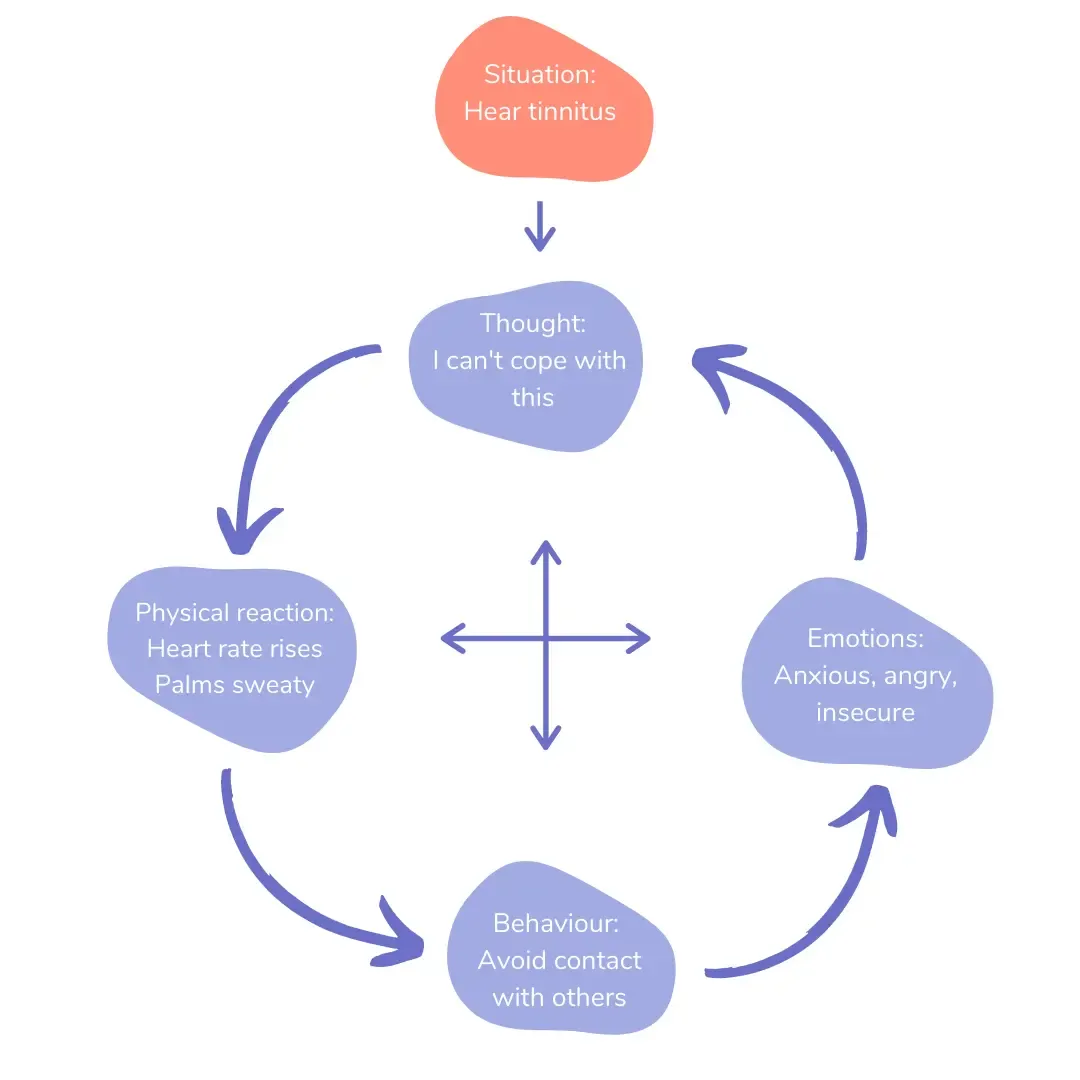
Neuroplasticity is the brain's ability to learn new thought patterns. The brain is constantly establishing new neural pathways. With CBT, you're able to consciously forge more helpful pathways.
There might be a number of beliefs that you hold about tinnitus. For example:
- I'll never be able to cope with this
- I'm not able to socialise with tinnitus
- No one has tinnitus as bad as mine
- I can't focus because of tinnitus
By identifying these beliefs, you can start to challenge whether they're accurate and true. This, in turn, will affect your thoughts and these then change how you feel, act and physically respond.
Some of the most common unhelpful thought patterns which surround tinnitus include:
- Predicting the future overly negatively
- Fixating on the negative
- Blaming yourself or others
- Denying the reality
- Thinking in an 'all or nothing' way
- Regretting past actions
CBT can help you understand these patterns and then learn cognitive skills to change them.
Techniques used in CBT for tinnitus
Some of the most effective techniques include:
- Cognitive restructuring: This involves identifying and challenging distorted thoughts that exacerbate tinnitus.
- Behavioural activation: This encourages you to engage in activities that not only bring joy but also aid in tuning out intrusive sounds.
- Mindfulness and relaxation: Techniques like deep breathing are employed to manage the stress often associated with the condition.
A CBT technique to try
One of the first cognitive skills you'll often learn in tinnitus therapy is the S.T.O.P.P tool.
You can try this quick exercise out when you next notice your tinnitus.
It aims to help shift your thought patterns into a more helpful place.
S: Stop
T: Take a breath - in through your nose for 5 counts and gently out through your mouth to the count of 7
O: Observe your reaction
P: Put your thoughts into perspective
P: Practice saying a more helpful thought
What can I expect from CBT?
When the brain perceives tinnitus it doesn't understand where the sound is coming from, so it goes into 'high alert' mode.
The primal part of your brain is programmed to pay attention to dangerous and important sounds, like a baby crying, or a siren.
This ‘high-alert’ system pushes adrenaline and other biochemicals through your body in case you need to run, fight or freeze.
Until the brain learns that your tinnitus noise is not the sound of something dangerous or harmful, your body will continue to produce this ‘high-alert’ effect. That is what makes hearing tinnitus so stressful and intrusive to your day to day life and why negative thought cycles are so common.
By consciously understanding the beliefs, attitudes and thoughts around tinnitus you'll be able to teach your brain that this is a sound it doesn't need to give attention: it isn't dangerous. The more your brain is 'fine' with your tinnitus, the less it will draw attention to it, and the less it'll intrude day to day.
Here's an example of a more helpful way to respond to the tinnitus sound you perceive:
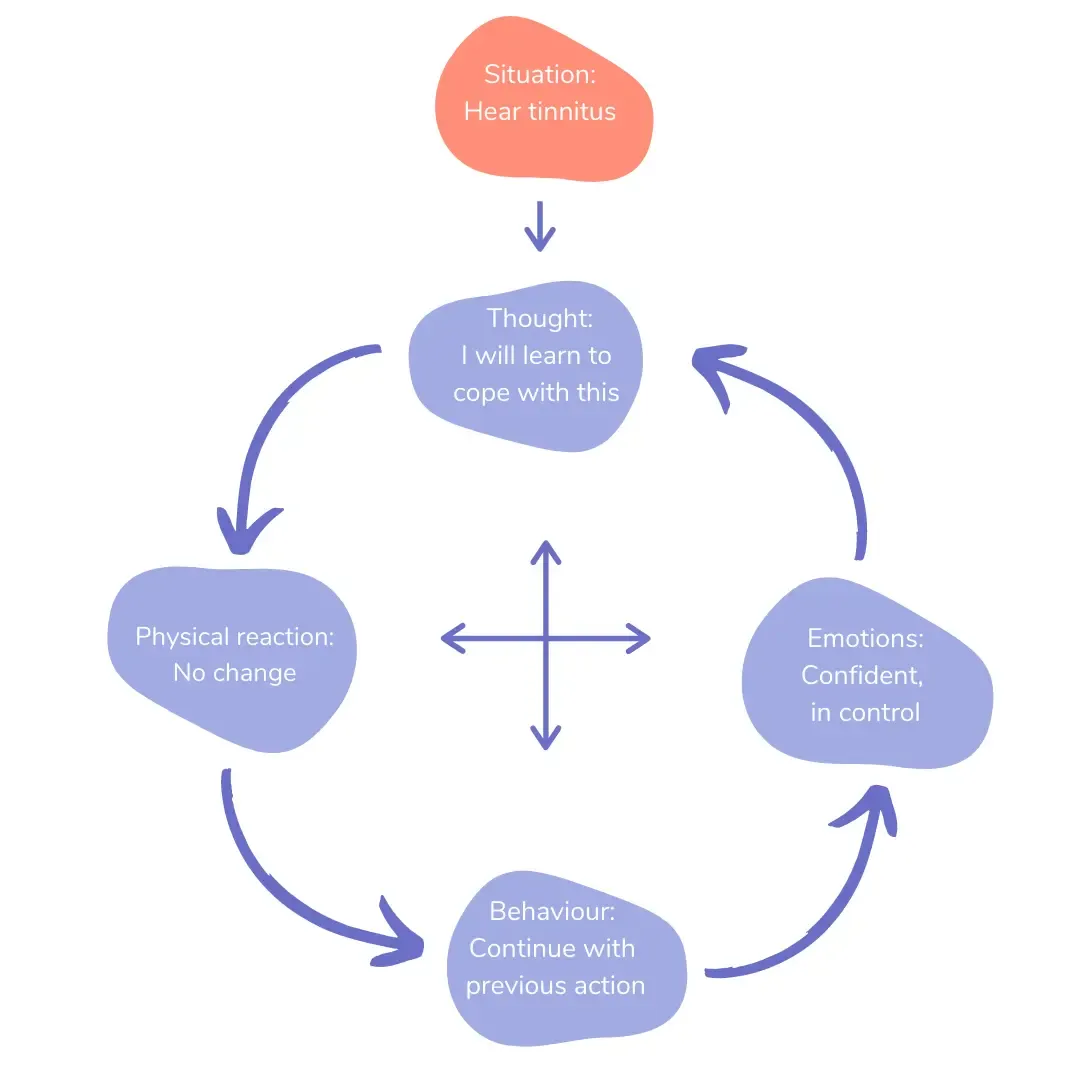
CBT can’t rid you of the perception of your tinnitus altogether, but it can help you learn how to tune out the sound you perceive.
At this moment, there's likely a pronounced connection between the sound of your tinnitus and how your brain reacts to it. When this sound enters your awareness, it often elicits negative emotions such as anxiety, sadness, fear, anger, or frustration.
Habituation modifyies your brain's response to the tinnitus sound. With time and effort, you can adjust this innate response, lessen its impact, or even completely tune it out.
How to access tinnitus CBT
CBT is normally offered in individual sessions but can sometimes be offered as group therapy.
CBT is a talking-therapy so it will involve talking to a therapist about different aspects of your tinnitus and how it affects you.
Whilst these sessions will be helpful, they rely on you working hard at the techniques in your own time.
The therapist will equip you with tools and techniques and then you can work out how to best apply these day to day.

There are different ways to seek in-person CBT sessions and professional help with your tinnitus.
For NHS tinnitus treatment, you can ask for a referral from your GP or follow a private healthcare route.
Recent guidance recommends digital CBT therapy delivered by psychologists as a good way to treat tinnitus. This is sometimes delivered in combination with mindfulness based therapy.
You might find this more accessible than in-person therapy which is often associated with high costs and long waiting lists.
More work is being done to provide digital CBT for tinnitus management.
Where Oto fits in
If you are looking for tinnitus CBT, start by booking an appointment with a tinnitus specialist. An audiologist who works with tinnitus can check your hearing, explain what is behind the sound, and tell you what is available to you locally, including talking therapy where that is appropriate.
What the Oto app contains
Oto is a smartphone app used at home alongside your own clinician. It contains:
- A sound library you can adjust: categories including urban, ASMR, 3D and nature sounds.
- Audio sessions: education, relaxation and mindfulness, including guided meditation and breathing exercises.
- Exercises drawing on cognitive behavioral techniques.
- Sleep content: sleep stories, mindfulness for sleep and wind-down routines.
- Guided stretches: neck, shoulders, back, jaw and arms.
Your audiologist sets the program up with you and reviews how you are getting on at follow-up. Oto is available on the App Store and Google Play.
The best tinnitus apps of 2026, compared
Conclusion
Tinnitus can be a life-altering condition, but it doesn't have to define you. As we've explored in this comprehensive guide, CBT stands as a beacon of hope, offering a scientifically backed approach to manage and even transform your experience with tinnitus.
From understanding the root causes and potential triggers to diving deep into the mechanics of CBT, we've covered how this therapy can help you challenge and change your negative thought patterns. This, in turn, can lead to a significant reduction in tinnitus-related distress, anxiety, and depression.
That evidence base is what separates CBT from most of what gets sold for tinnitus. No vitamin or supplement has been shown to reliably improve it.
And remember, you're not alone on this journey. If tinnitus is affecting you, book an appointment with a tinnitus specialist. Oto is a smartphone app used at home alongside that care, with a sound library, audio sessions and a community of other people with tinnitus.
To find out whether Oto is a fit for you, start here.
Reference
- NICE. (2020, March 11). Tinnitus: assessment and management (NICE guideline [NG155]). National Institute for Health and Care Excellence. Retrieved from https://www.nice.org.uk/guidance/ng155/chapter/Recommendations#management-of-tinnitus
- Martinez-Devesa, P., Perera, R., Theodoulou, M., & Waddell, A. (2010). Cognitive behavioural therapy for tinnitus. The Cochrane database of systematic reviews, (9), CD005233. https://doi.org/10.1002/14651858.CD005233.pub3
- Landry, E. C., Sandoval, X. C. R., Simeone, C. N., Tidball, G., Lea, J., & Westerberg, B. D. (2020). Systematic Review and Network Meta-analysis of Cognitive and/or Behavioral Therapies (CBT) for Tinnitus. Otology & neurotology: official publication of the American Otological Society, American Neurotology Society [and] European Academy of Otology and Neurotology, 41(2), 153–166. https://doi.org/10.1097/MAO.0000000000002472
- Fuller, T., Cima, R., Langguth, B., Mazurek, B., Vlaeyen, J. W., & Hoare, D. J. (2020). Cognitive behavioural therapy for tinnitus. The Cochrane database of systematic reviews, 1(1), CD012614. https://doi.org/10.1002/14651858.CD012614.pub2
FAQs
What is Cognitive Behavioural Therapy (CBT) for tinnitus?
CBT is a form of talking therapy that focuses on identifying and modifying negative thought patterns and behaviors related to tinnitus to improve emotional well-being and coping skills.
How effective is CBT in treating tinnitus?
Numerous scientific studies have shown that CBT can be successful in reducing the perception of tinnitus and its associated distress, depression, and anxiety.
How does CBT work for tinnitus?
CBT helps individuals recognize and challenge negative thoughts and beliefs about their tinnitus. By changing these patterns, it can lead to reduced attention to tinnitus and decreased distress.
What are some common negative thought patterns associated with tinnitus?
Common patterns include predicting the future negatively, fixating on the negative, blaming oneself or others, denying reality, and regretting past actions.
What is the S.T.O.P.P tool in CBT for tinnitus?
It's a quick exercise to help recognize and change common thought patterns. The steps are: Stop, Take a breath, Observe your reaction, Put thoughts into perspective, and Practice a more helpful thought.
How can I access CBT for tinnitus?
CBT can be accessed through individual or group therapy sessions. It can be sought through NHS referrals or private healthcare routes. Digital CBT therapy is also becoming more accessible and widespread.
What are the recommendations from leading health organizations about CBT for tinnitus?
Organizations like the American Academy of Otolaryngology, NICE in the UK, and European healthcare guidelines recommend CBT as an effective treatment for tinnitus.
Can CBT cure tinnitus?
While CBT cannot eliminate the perception of tinnitus, it can help individuals habituate to the sound, making it less bothersome and intrusive in daily life.
What is the role of neuroplasticity in CBT for tinnitus?
Neuroplasticity refers to the brain's ability to form new neural pathways. With CBT, individuals can consciously develop more helpful methods to help process the perception of their tinnitus. This is called tinnitus habituation.
How can the Oto app assist those with tinnitus?
The Oto app contains a sound library, audio sessions covering education, relaxation and mindfulness, sleep support, exercises drawing on cognitive behavioral techniques, and guided stretches. It is used at home alongside your own clinician.